Showing posts with label Articles. Show all posts

Tuesday, January 27, 2026

Why is the New World named “America,” after Amerigo Vespucci, and not after Columbus who discovered it?


“The Four Voyages” and “Mundus Novus” were letters written by Vespucci describing his explorations in the New World. They were published in Florence, and republished in other countries including France and Germany.  


The popularity of the letters was due to Vespucci’s insistence that the newly discovered lands were a new continent… These letters were so widely read that as a consequence Vespucci emerged as a major figure in sixteenth-century exploration and discovery, and for more than a generation his claims overshadowed the achievements of Columbus. [1] 


In 1506, German cartographer Martin Waldseemüller published the letters under the name, The Cosmography. The book included a world map with the New World named “America.” This was because he was convinced Vespucci was the one who discovered it. Waldseemüller wrote:


I do not see why anyone would rightly forbid calling it (after the discoverer Americus [sic]...) [2]


Eventually, Waldseemüller and his colleagues accumulated more information from learning about the Spanish and Portuguese discoveries. They revised the earlier misconceptions including the fact “that the lands discovered by Columbus and those reported by Vespucci were the same.” [3] Unfortunately, Waldseemüller erroneously called Columbus a “Spaniard” and though he removed the name “America” (from other geographical works he later published), the name “America” stuck and replaced the name of the Indies. 


How was the relationship between Columbus and Vespucci?


Columbus made a total of four voyages. He was the first European to reach and discover Central America, South America and the Caribbean. He reached the continent first (in 1498), one year before Vespucci did. However, Vespucci claimed in his letters he was there a year before Columbus. Primary source Bartolome de las Casas believed Vespucci was in bad faith, lying, “usurping the glory and honor due to Columbus alone… and deliberately sought to steal the admiral’s glory.” He complained that the New World was unfairly named after Vespucci, that it should have been after Columbus instead. [4] Nevertheless, there was never animosity between Columbus and Vespucci. The claim of reaching the continent a year before Columbus by Vespucci was one of a few errors in the text that eventually got fixed. As for the renaming of the continent, that was out of the control of Columbus since he died as Waldseemüller was about to use the name “America” in his work.


It is important to understand that Vespucci’s initial voyage to the continent was not one he made by himself as the leading explorer. He was there as part of the crew, probably serving as an astronomical observer. Instead, the expedition was led by Alonso de Ojeda in 1499 to 1500 who reached the continent because he had seen Columbus’ map. [5] 


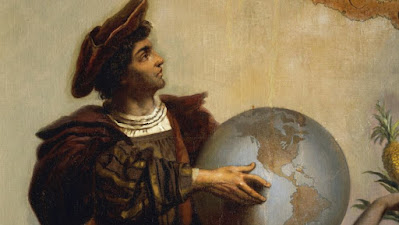
What is the letter Columbus is giving to Vespucci in the image above?


As mentioned before, Columbus knew Vespucci. He even mentions him in two private short letters Columbus wrote to his son Diego in 1506, before he died. 


ChatGTP vs History:


For some strange reason ChatGTP says that in the first letter “Columbus complains that Vespucci had risen in royal favor while he (Columbus) had been neglected,” and “Columbus feels Vespucci advanced because of politics and luck, not achievement.” In the second letter, according to the chat, Columbus says that Vespucci “Tried to take credit for discoveries that were not his… Was now being treated as an authority on navigation… Columbus also warns Diego not to trust Vespucci fully and implies that Vespucci benefited from Columbus’s downfall.”


None of the above is true. In fact, it is pure fantasy.


In the real first letter Columbus wrote, he described Vespucci as a very good man, always looking to please him and do anything that he could to help. Columbus even laments for Vespucci by saying, “Fortune has been against him like it has been for many others: his efforts have not benefited him as much as reason demands.” [6] Vespucci personally carried that letter to Columbus’ son, Diego as we can see in the image of this post. As for the second letter, Columbus says he was writing the letter with Vespucci by his side.


What was Vespucci's contribution to history? 


Vespucci was the first person to realize the Indies was a different continent and not part of Asia. Vespucci called it the fourth part of the world; the other three being Europe, Africa and Asia. He wrote:


… for in those southern parts I have found a continent more densely peopled and abounding in animals than our Europe or Asia or Africa. Mundus Novus, p. 1.


… it is evident that we sailed over a fourth part of the world… Mundus Novus, p. 11.


Vespucci’s enthusiasts use this as their defense for the New World being “correctly” named America and not Columbia or Columbus. But if we were going to follow Waldseemüller’s logic, it should have been named after their discoverer. 


Life sometimes is not fair. Regardless, many places are still named after Columbus, including capitals, cities, towns, companies, islands, etc., and even a country.


Ironically, the greatest accomplishment by Amerigo Vespucci is the realization that Columbus’ discoveries were one of the greatest events in history! The New World is now in the maps because of Columbus.


---------------------------------------


Footnotes:


1. The Christopher Columbus Encyclopedia. Vol. I, p.18.

2. Ibid p.19.

3. Ibid p. 21.

4. History of the Indies by Las Casas, Book One, Ch. 163, pp. 61-62.

5. Ibid.

6. Colección de los Viajes y Descubrimientos by Martín Fernández de Navarrette, p. 351. Translation into English made by me. 


Sources:


1. The First Four Voyages of Amerigo Vespucci. Translated by Stradanus. London. 1893.

2. Mundus Novus by Amerigo Vespucci - Letter to Lorenzo Pietro Di Medici. Translated by George Tyler Northup. Princeton University Press. 1916.

3. America, Naming of, pp. 18-21. The Christopher Columbus Encyclopedia. Volume I. Simon & Schuster. 1992.

4. Colección de los Viajes y Descubrimientos que Hicieron por Mar los Españoles Desde Fines del Siglo XV by Martín Fernández de Navarrette. Tomo I. 1825.


#amerigovespucci #mundusnovus #america #diegocolumbus #chatgtp #martinwaldseemüller #columbus


Saturday, September 6, 2025

"Get Gold, Humanely If Possible, But At All Hazards- Get Gold”


Did King Ferdinand tell Christopher Columbus to “Get gold, humanely if possible, but at all hazards-get gold”?


The short answer to the question is in Chapter 19 of my book, “Christopher Columbus The Hero 2”:


Revisionists are becoming more creative in the things they incorrectly attribute to Columbus. One of the new ones is that King Ferdinand wrote a letter to Columbus on June 6, 1511, saying, ‘Get gold, humanely if possible, but at all hazards-get gold.’ This quote is in several articles on the web, even in a school textbook. But the first problem we have is that Columbus died in 1506. The other problem is that the king did not say such a thing. Instead, the quote was a comment made by Sir Arthur Helps in 1856. It has nothing to do with Columbus. [1]


In addition, Sir Arthur Helps wrote a biography on Columbus where he portrayed him as a hero. His book is titled “The Life of Columbus.”


Sir Arthur’s “Get gold comment” comment came from another book he wrote [2]. In it, he quoted a letter King Ferdinand wrote to Diego Columbus (Columbus’ son) in 1511 by saying:


The conversion of the Indians is the principal foundation of the conquest, that which principally ought to be attended to. So act that the Indians there ( in Trinidad ) may increase, and not diminish, as in Hispaniola.


That’s the actual quote. Then Sir Arthur proceeded to comment the following:


This is a most unsatisfactory and vacillating letter, which it is not harsh to construe shortly in this way: ‘Get gold, humanely if you can, but at all hazards get gold, and here are facilities for you.’ The king tries to wash his hands of the ill consequences of this permission in a letter of the next month, in which he says, ‘Take care that our conscience be not burdened, and that the importation of Indians be without damage to them and to our people ...’  [3]


Whereas Sir Arthur saw Columbus with grace, he didn’t extend that benefit to the Spanish kingdom. Then he added, “These are but useless words: how was it possible to enter a country, take a number of its people, and transport them to another place, in any velvet manner?” 


This is an ironic statement since Sir Arthur’s country of origin (England) became an empire by entering other countries, and they participated in the transatlantic slave trade as well. Not to mention that slavery was universal during the Spanish conquest era. This is clearly an anti-Spanish bias comment.


I will recommend people to read the entire letters [4] Sir Arthur Helps partially quoted and commented on, and I will challenge anyone to prove to me where the Spanish kingdom approved the abuse of the natives. They never did. In fact, it was unlawful. Those who did were reported and punished. In contrast, the Indigenous natives practiced slavery, accompanied with sanctioned abuses like cannibalism and human sacrifices. Yet, that part of the story is often swept under the rug.This is not a comment to shame the Indigenous people, but to bring a perspective that is usually ignored. 


History is history, and universal slavery was part of it. Thankfully, we don’t practice it anymore. But to answer the question of this post, Did Christopher Columbus receive a letter saying, “Get gold Get gold, humanely if possible, but at all hazards-get gold”? The answer is, “no.”


Footnotes:
1. Christopher Columbus The Hero 2 by Rafael Ortiz, Chapter 19, p. 157.
2. The Spanish Conquest in America, and its Relation to the History of Slavery and to the Government of Colonies. Vol. I. 1856. 
3. Ibid, p. 234.
4. The title of the book is, Colección de Documentos Inéditos Relativos al Descubrimiento, Conquista y Organización de las Antiguas Posesiones Españolas de Ultramar. Tomo 5, De Los Documentos Legislativos, I. Madrid, 1890. The ebook version is free on Google Play Books.


#sirarthurhelps #getgoldhumanely

Tuesday, July 29, 2025

"Genoan Monk Mentioned America" or "Italians Knew About America 150 Years Before Columbus" Debunked


It is sad how many people share “news” links based on the headline, without taking the time to read the article. Many times the article contradicts the headline because it is just clickbait, or as in this case, a reflection of the ignorance of the publisher. This year (2021) we have several headlines circulating the news claiming that “Italians knew about America long before Columbus...” NY Post

Another headline was “Ancient Documents Suggest Italian Sailors Knew of America 150 Years Before Christopher Columbus.” SciTechDaily


Or that “The First Mention of America” was made in 1340. (Taylor & Francis Online). Taylor & Francis Online


The headlines above are a reference to an unfinished unpublished book by a Genoan monk named Galvaneus Flamma (14th century) where Markland (Marckalada) is mentioned. Markland is supposed to be somewhere in North America. This document was “recently” found (2015) by a professor of Medieval history named Paolo Chiesa.


Here are the reasons why the headlines are ALL incorrect: America is NOT mentioned by the monk in 1340, nor by anyone else before him, because Amerigo Vespucci (where the name “America” comes from) was a contemporary of Columbus and not of Galvaneus. 


If by America what they mean is Markland, then the headline is incorrect since Markland is not the “old” name for America. The name of Markland was not new either since it was mentioned in several sagas, like the “Saga of Erik the Red” (written in the 13th century). https://en.wikipedia.org/wiki/Saga_of_Erik_the_Red


If what they mean by “America” is the knowledge that there is a continent in between Europe and Asia, then the headline is incorrect again, since Galvaneus did not make such a claim. 


All this is evidence that people don’t understand Columbus’ discoveries, so let me explain. But first, let’s take a look at the claims made by Galvaneus, the Genoan monk. 


I’m writing the following under the premise and assumption that there is no forgery on this Genoan document. The reason for mentioning this is because many elaborate hoaxes have been used in the past (and in recent years), trying to discredit Columbus. I wrote an entire chapter on this subject in my third book “Christopher Columbus and the Christian Church” titled, “Hoaxes, Forgeries and Crimes.”


One of the articles above, written by Taylor and Francis Online, contains excerpts from Galvaneus’ account known as “Cronica universalis.”  The account doesn’t contradict Columbus at all, but confirms what we already knew about the subject. For example, the Cronica mentions Marco Polo, whom Columbus was inspired after. Marco Polo’s accounts are about the Indies, or Asia, the east side of the world. Then the Cronica talks about the west side of the globe, when it mentions Yslandia (Iceland) and Grolandia (Greenland). The Cronica does not mention anything of another continent in between Asia and Europe. Though it mentions “Marckalada” [Markland], which it’s believed to be in North America today, the article acknowledges “the news about” it was vague, and nothing “for sure.” In fact, the ancient cosmographers did not know there was a continent in between Asia and Europe. Maps ended with Iceland and Greenland which they called “Tile” or “Thule.” Cartographers added imaginary islands on maps in this area because, as stated and confirmed by Galvaneus, “no sailor was ever able to know anything for sure about this land or about its features.”


Columbus himself had visited Tile (Iceland) 15 years before his discoveries. He wrote, “In the month of February, 1477, I sailed one hundred leagues beyond the island of Tile [Iceland]...” Source: The Life of the Admiral by Ferdinand Columbus, Chapter 4, p. 11.


The only “new” thing here is that Markland is mentioned in the Cronica. But even that is not new either, since the article acknowledges Markland was mentioned by the aforementioned Icelandic sagas. What the article finds “exceptional” is that Markland is mentioned here, outside a Nordic saga.


Though I discussed it many times before (in books, blogs and videos), I’m forced to repeat myself here to explain the difference between Columbus and the “Vikings,” or Norsemen (the explorers of the Nordic sagas):


The Norsemen were not trying to reach the Indies, or Asia, as Columbus intended. When one looks at a world map, one will see that on the north side of the globe there are many lands in between Europe and America. That includes England, Ireland, Iceland and Greenland. People believed that after Thule (Iceland/Greenland) there was nothing but water. All the Norsemen did was what everyone else had done before them: Sail from land to land. The lands are close to each other.


They sailed from the continent to England, to Ireland, to Iceland, till one day one of them, Erik the Red, found Greenland, which is next to Iceland. They lived there, which was where the maps ended. Later, as some of them were returning to Greenland, the waves took them further to the lands next door, which are part of North America. Source: The Saga of Eirik the Red, pp. 23-24.


They never thought they were on the Indies or in a continent in between. According to scholar Paolo Emilio Taviani, “Greenland and lands beyond were for them simply other lands of Europe.” Source: The Grand Design by Taviani, p. 90.


As for Columbus, he intended to pass Thule until he reached the Indies (Asia). But unlike the Norsemen, he left from the center/south side of the globe, where there are no close lands to make stops, as one can do on the north. He literally sailed into the unknown. The sea route was known as “the Sea of Darkness.” His sailors initially rigged twice one of the ships; they wept when they could not see the land anymore; they complained every day; they threatened Columbus’ life a few times. But in the end they reached land because he was right. 


If sailors knew that America was close, why did they give Columbus a hard time? 


We all know that Spain helped Columbus with his enterprise. But most people don’t know he had lived in Portugal and made his first request to fund his enterprise there. Portugal denied his request and ridiculed him. Columbus moved to Spain where he was ridiculed again. Some people think he also requested Genoa for assistance, but they also said “no” to him. Columbus sent his brother Bartholomew to lobby for him in England. After waiting for seven years for a response, Spain denied Columbus as well, so he made his way to France when the Queen of Spain had a change of heart and sent for him to return. 


The point here is that if people knew about “America,” why then did Columbus have a hard time getting support and received so much ridicule instead? Why did Portugal deny him help when Portugal was the leading force of discovery during Columbus’ residence there? Why did England not respond to his brother right away? If “Italian sailors knew about America” before Columbus, why did Genoa not help him? If people knew about America, why then did the Spanish council mock Columbus and tell him there was no land (or people) where he wanted to go?


Someone might say that “perhaps Columbus knew about America because of the Genoan monk and his Cronica.” That would be a conspiracy theory and not history. Besides, Galvaneus’ Cronica was unfinished and unpublished. Again, that is assuming the Cronica is not a hoax. As for the Nordic sagas, Columbus never mentioned them, nor did he need them since they never claimed the Norsemen were trying to reach the Indies, nor that they did, or that they found a “new” continent. Columbus’ ideas were based on the great cosmographers of the past, including Ptolemy, Pliny, Marinus, Aristotle, Strabo, Pierre d’Ailly, Capitolinus, etc. They all either believed that the earth was smaller than it is, and/ or that Indies were not far from Spain or Europe. There was also a contemporary cosmographer named Toscanelli who had written to Columbus saying the same. Source: The Life of the Admiral by Ferdinand Columbus, Chapters 6-8. 


The “professionals” who made fun of Columbus seem not to be aware of this kind of information. They also have their share of myths and unproven hypotheses. It was Columbus who took the risk against all odds. Once he proved that it was safe to sail west, other explorers followed and finished the maps he started. This eventually led to the realization that Columbus’ discoveries were bigger than anyone thought; and here we are today.


Before someone makes the usual snarky comment that “Columbus discovered an insignificant island in the Caribbean:” He actually explored most, if not all, of the Caribbean, and he later reached and explored the continent in Central and South America. North America was reached later due to him, when England heard of his success. In addition, one of his men (Juan Ponce de Leon) explored Florida in North America.


I would suggest the readers to read Columbus’ primary sources to see and understand more of what people believed about cosmography at the time. “The Life of the Admiral” by Ferdinand Columbus is a good start. My books go into great depth on this subject as well. 


As we can see, real history is more complex than people may think today. Many people are not reading history. They are guessing “history,” making conclusions based on modern-day perceptions. 


In summary, there is no document claiming or proving that people knew that “America” existed before Columbus. That is fake news. It is just clickbait rooted in misunderstanding, error, and sensationalism.


#GenoanMonk #GalvaneusFlamma #Markland #AmericaBeforeColumbus


Christopher Columbus was 100% Italian


Columbus was born in Genoa, Italy. Anyone who says otherwise is not a historian but a conspiracy theorist. There is NOT one single primary source that says Columbus was NOT from there. All primary sources, including Columbus himself, say he was. 


Here is what the primary sources had to say:


1. Andrés Bernáldez [1] (1450 - 1513) said, “There was a man of Genoa… that was called Christopher Columbus” (“Obo un hombre de Génova… que llamaban Christoval de Colon…” Historia de los Reyes Católicos by Andrés Bernáldez, Tomo I, Cap. CXVIII, p. 269. Translation from Archaic Spanish to English made by me).


Bernáldez was a historian and the archbishop of Seville, Spain. He was a friend of Columbus, and Columbus had stayed at his house a few times. 


2. Fray Bartolomé de las Casas [2] (1484 - 1566) called Columbus “the illustrious Genoese Christopher Columbus…” History of the Indies by Las Casas, Book One, Ch. 3, p. 15.


Las Casas was a friar, priest, bishop, and historian who personally knew Columbus and he testified Columbus had a foreign accent.


3. Peter Martyr d'Anghiera [3] (1457 - 1526) wrote that “A certain Christopher Columbus, a Genoese, proposed to the Catholic King and Queen, Ferdinand and Isabella, to discover the islands which touch the Indies, by sailing from the western extremity of this country.” De Orbe Novo by Peter Martyr, The First Decade, Book I, p. 57.


Martyr was another historian, scholar, and chaplain to the court of King Ferdinand and Queen Isabel. He was a friend of Columbus as well, but like Columbus, he was Italian. Martyr was born in Arona, Piedmont, which is 119.7 miles from Genoa, Italy. If anyone knew Columbus was not Italian, it was him.


4. Christopher Columbus himself said he was born in Genoa, Italy. In a letter he wrote in 1498 to secure his eldest son’s rights of primogeniture (institución de mayorazgo) he said, “I was born in Genoa [and] I came to serve you [the king and queen] here in Castile.” (“... que siendo yo nacido en Génova les vine á servir aquí en Castilla..” Relaciones y Cartas de Cristóbal Colón, p. 248).


In the same letter Columbus requested his heir to always help someone of “our lineage” in the “city of Genoa” because “from there I came and from there I was born” (“... que tenga y sostenga siempre en la ciudad de Génova una persona de nuestro linaje que tenga alli casa é mujer, é le ordene renta con que pueda vivir honestamente, como persona tan llegada á nuestro linaje, y haga pie y raiz en la dicha Ciudad, como natural della, porque podrá haber de la dicha Ciudad ayuda é favor en las cosas del menester suyo, pues della salí y en ella nací.” Relaciones y Cartas de Cristóbal Colón, p. 254).


That’s the quote used in the meme at the top of this article. The ellipsis was made to fit the sentence in the meme. The full letter is available here (in Spanish): www.cervantesvirtual.com/


5. Amerigo Vespucci [4] (1451 - 1512), from whom America’s name is derived, was another Italian explorer who had met Columbus as well. Vespucci himself delivered a letter Columbus wrote to his eldest son, Diego, in 1505.


You can read the letter here: www.cambridge.org/


Like Martyr, Vespucci would have known for sure if Columbus was Italian or not. 


6. Gonzalo Fernández de Oviedo [5] (1478 – 1557) wrote: “Christopher Columbus, according to what I know from people of his nation, was a natural of the province of Liguria, which is in Italy, where… Genoa is” (“Chripstóbal Colom, segun yo he sabido de hombres de su nascion, fue natural dela provincia de Liguria, que es en Italia, en la qual cae la cibdad é señoria de Génova.” Historia General y Natural by Oviedo, Lib. II, Cap. II, p. 12. Translation from Archaic Spanish to English made by me). 


At the time, Genoa was a republic. Today Genoa is the capital of Liguria, Italy. Oviedo was a Spanish historian who served the king and queen’s court during the times of Columbus’ discoveries.


If Columbus was a Spaniard, how come none of his Spanish friends and Spanish historians above didn’t know about it? Were they that foolish? Were Columbus’ Italian friends also that dumb?


7. Antonio de Herrera y Tordesillas [6] (1549 – 1625 or 26) wrote: “Don Christopher Colombo, which for easier pronunciation was called ‘Colón’, born in the city of Genoa” (“D. Chriftoval Colombo, à quien por mas comoda pronunciacion, dixeron Colòn, nacido en la Ciudad de Genova…” Historia General by Herrera, Década I, Lib. I, Cap. VII, p. 11. Translation from Archaic Spanish to English made by me).


Though Herrera was not alive during the times of Columbus, his historical work is considered one of the best.


Italian historian Paolo Emilio Taviani brings more evidence of Columbus being born in Genoa in his book The Grand Design. He uses the testimonies of several ambassadors of the period: 


  1. Pedro de Ayala was the Spanish Ambassador to the English court. In 1498 he wrote to King Ferdinand and Queen Isabel concerning John Cabot, (who was Italian as well) and his discoveries. In the same letter Ayala affirmed Columbus’ Genoese birth.


  1. Nicolo Oderico was ambassador of the Republic of Genoa to Spain. In a letter on April 1501, he praised Spain for their discoveries under Columbus’ leadership by saying “our fellow citizen, illustrious cosmographer and stedfast leader.”


  1. Angelo Trevisan was chancellor and secretary to Domenico Pisano, from the Venitian Republic’s envoy to Spain. Trevisan wrote to Domenico Malipiero, a member of Venice’s Council of Pregadi and said, “I have succeeded in becoming a great friend of Columbus... Christoforo Colombi, Genoese, a tall, well-built man, ruddy, of great creative talent, and with a long face.”


  1. Gaspar Contarini was Venice’s ambassador to Spain and Portugal. In November 1525, as he was reporting to the Senate of the Venitian Republic on the whereabouts of Hispaniola, he spoke of the Admiral Diego Columbus, who was Columbus’ son. He said, “This Admiral is son of the Genoese Columbus and has great powers, granted to his father.”


All of the above is in Chapter II of Taviani’s book. In Chapter III, Taviani brings more evidence of Columbus’ Genoan origins, where he, his father, grandfather, and other family members are mentioned in Genoan contracts, documents, deeds of sale, and the like. Here are a few examples: 


A 1429 contract mentions Columbus’ grandfather, Giovanni.  Another document indicates he was dead by 1444. 

Columbus’ father, Domenico, is mentioned as a master weaver in 1447. 


Records indicating Domenico was appointed as a warder of Porta dell’Oliviela, in Genoa. 


At some point Domenico moved, as he is mentioned as working in Savona in 1470, but six months later he moved back to Genoa with Columbus. Both names, Domenico and Columbus, are mentioned in a contract. 


Another document shows Domenico selling his house in Genoa in 1473. 


In another, Domenico was a witness to a notarial deed drawn up in Genoa on 30 September 1494, etc.


Taviani also reminds the reader that subsequent historians and geographers, including those from Spain, Portugal, Germany, England, the Netherlands, Switzerland, France, and Turkey, affirmed Columbus was a Genoan. 


Note, that the house Columbus grew up as a child is now a museum in Genoa, Italy. [7]


I’m not writing any of this because of “my heritage” since I’m not an Italian American. I’m writing all this because facts are facts, and truth still matters.


"Christopher Columbus, the Last Templar" by Ruggero Marino Book Review

Ruggero Marino is well acquainted with history in general. The problem is how he interprets it when it comes to Columbus. Here is when his b...